

Trees are one of the best parts of living in Astoria. They add shade, privacy, beauty, wildlife habitat, and character to coastal properties. But trees can also become liabilities when structural problems, decay, storm damage, or root issues go unnoticed.
That doesn’t mean every large tree is dangerous. It does mean trees should be evaluated with the same care you would give any important part of your property. A professional tree risk assessment helps identify potential concerns before they become emergencies, giving you a clearer path forward.
For home and business owners, HOAs, and property managers on the North Oregon Coast, tree risk assessments can be especially valuable because coastal weather puts constant pressure on trees.
What Is a Tree Risk Assessment?
A tree risk assessment is a professional evaluation of a tree’s condition, structure, surroundings, and likelihood of failure. The goal is not to create fear or recommend removal automatically. The goal is to understand the actual level of risk and determine what, if anything, should be done.
During a tree risk assessment, an arborist may evaluate:
Tree structure
This includes trunk condition, branch attachments, cracks, splits, cavities, and other visible defects that may affect stability.
Root and soil conditions
Roots anchor the tree. If roots are damaged, buried, decayed, or growing in saturated or compacted soil, the entire tree may be less stable.
Canopy health
Dead limbs, thinning foliage, sudden dieback, or uneven crown growth may suggest stress, disease, or structural imbalance.
Nearby targets
Risk depends partly on what the tree could hit if it failed. A tree over a house, road, driveway, parking area, or public space requires closer attention than one in a low-use area.
Why Tree Risk is Important to Assess in Astoria, Oregon
Astoria’s coastal environment creates specific challenges for tree stability. High winds, heavy rain, saturated soils, and storm exposure can all increase the likelihood of branch failure or whole-tree failure, especially when a tree already has structural weaknesses.
Trees on slopes, near roads, close to homes, or growing in tight urban spaces may face additional pressure. Construction, trenching, grade changes, and soil compaction can also weaken roots long before visible symptoms appear.
That is why waiting until a tree looks obviously dangerous is not the best approach. By then, your options may be limited to emergency work or removal.
Signs You May Need a Tree Risk Assessment
You certainly don’t need to call about every tree on your property every week, but specific warning signs do deserve attention.
Consider scheduling a tree risk assessment if you notice:
A sudden lean
A tree that has recently started leaning, especially after heavy rain or wind, should be evaluated.
Cracks or splits in the trunk
Visible cracks can indicate structural weakness, particularly when they extend into large limbs or the main trunk.
Large dead branches
Dead branches can fall unexpectedly, especially during storms.
Mushrooms or fungal growth near the base
Fungal growth near the root flare may indicate decay or root disease.
Soil lifting around the roots
Raised or cracked soil near the base can suggest root plate movement.
Recent construction near the tree
Excavation, grading, paving, or utility work can damage roots and increase future risk.
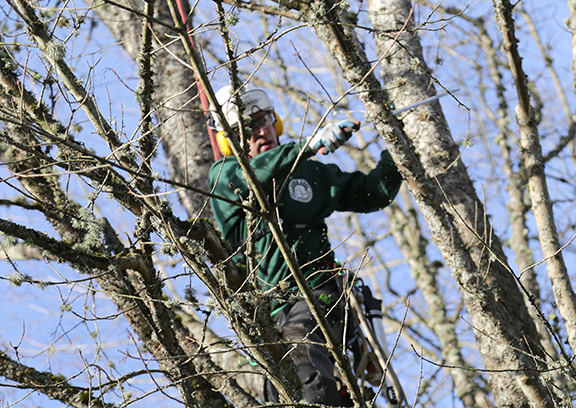
A Risk Assessment Does Not Always Mean Removal
One of the biggest misconceptions about tree risk assessments is that they are just a step toward cutting a tree down. In reality, a good assessment may help preserve a tree by identifying practical ways to reduce risk.
Depending on the tree and site, recommendations may include:
- selective pruning
- cabling and bracing
- plant health care
- root-zone improvements
- moving targets away from the tree
- monitoring the tree over time
- removal when the risk is unacceptable
The International Society of Arboriculture notes that arborists may recommend pruning, cabling and bracing, routine care, target management, or removal depending on the tree’s condition and risk level.
• Learn more from the International Society of Arboriculture
How Arbor Care Tree Specialists Helps Reduce Tree Risk
Arbor Care Tree Specialists provides professional tree consulting services for homeowners, businesses, municipalities, and property managers throughout the North Oregon Coast and SW Washington. Their ISA Certified Arborists evaluate trees with an eye toward safety, tree health, and long-term property value.
A tree risk assessment may lead to several possible service recommendations.
Related services:
When Tree Pruning Can Lower Risk
Pruning can reduce certain types of risk when it is done correctly. Removing dead, damaged, or poorly attached branches can help protect homes, walkways, vehicles, and people below. Structural pruning may also help improve long-term stability.
However, improper pruning can make a tree weaker. Over-thinning, topping, or removing too much live canopy can increase stress and create future hazards. That is why risk-related pruning should be handled by professionals who understand tree structure.
When Cabling and Bracing May Help
Some trees have weak branch attachments, split trunks, or large limbs that need added support. In the right situations, cabling and bracing can help reduce movement and provide additional stability.
Cabling and bracing are not guarantees against failure, and they are not appropriate for every tree. But when installed correctly and monitored over time, support systems can help preserve valuable trees that might otherwise be at higher risk.
When Removal Is the Responsible Choice
Sometimes a tree is too damaged, decayed, unstable, or poorly located to manage safely. In those cases, removal may be the most responsible decision.
Tree removal may be recommended when:
- the tree has severe structural defects
- root failure is likely
- decay has compromised stability
- the tree threatens a home, road, utility line, or public area
- storm damage has made the tree unsafe
Removal is never a recommendation to take lightly, but delaying necessary removal can increase danger and cost.

The Best Time to Get a Tree Risk Assessment
The best time to assess risk is before a tree fails. For Astoria property owners, a few especially smart times include:
- before winter storm season
- after major wind or rain events
- before buying or selling a property
- before construction, grading, or excavation
- when a tree shows new cracks, lean, dieback, or root disturbance
- when a large tree is close to a home, road, or utility line
You do not need to wait for an emergency to ask whether a tree is safe.
Schedule a Tree Risk Assessment in Astoria, Oregon
If you are concerned about a tree on your property, Arbor Care Tree Specialists can help you make an informed decision. Whether the right answer is pruning, support, plant health care, monitoring, or removal, a professional assessment gives you clarity.